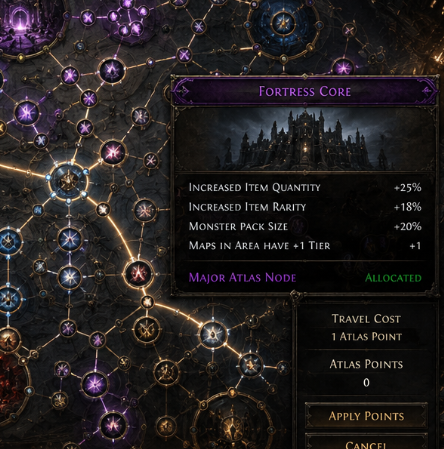
The late-game mapping system in Version 0.5 has been completely redesigned, introducing a more structured progression path centered around the Precursor Fortress system. Instead of unlocking the Atlas gradually through traditional mapping, players now progress through a dedicated questline and fortress-based challenges that unlock passive tree access step by step.
Understanding how this system works is essential for efficiently scaling into high-tier maps and maximizing endgame rewards.
Unlocking the Atlas Through the Precursor Fortress
The new Atlas progression is tied directly to a structured series of fortress encounters and quest milestones. Each stage unlocks additional passive tree capacity and improves your ability to specialize in endgame farming strategies.
Core Unlock Requirement
The primary gateway to the Atlas Passive Tree is completing the Origins of Divinity questline. This multi-stage progression introduces players to high-density mapping zones and fortress guardians that must be defeated to advance.
Once completed, players gain access to the foundational Atlas system and begin unlocking passive nodes.
Atlas Passive Tree Progression Overview
The system contains a large number of nodes designed to customize mapping efficiency, league mechanics, and reward scaling. Proper planning is essential to avoid inefficient progression.
Key Optimization Principles
Prioritize major cluster notables over minor stat nodes
Specialize early into specific league mechanics
Avoid spreading points too thin across multiple regions
Focus on efficiency rather than full node completion
| Stage | Requirement | Reward |
| Early Access | Complete Origins of Divinity questline | Unlock basic Atlas passive tree |
| Mid Progression | Defeat Atlas Masters in fortress regions | Expand passive node capacity |
| Advanced Mapping | Complete high-tier fortress zones | Unlock specialized farming clusters |
| Endgame Optimization | Full region specialization | Maximum item quantity scaling |
Efficient Map Strategy for Progression
To progress smoothly through the Atlas system, players should focus on structured mapping rather than random exploration.
Recommended approach:
Run connected fortress-linked maps
Focus on regions aligned with your chosen farming strategy
Prioritize map completion bonuses early
Save high-value modifiers for higher-tier maps
Efficient routing through these systems significantly improves both progression speed and currency generation.
Sustaining High-Tier Mapping
As you move deeper into the Atlas system, map sustain becomes increasingly important. High-tier maps and consumables are required to maintain progression speed and maximize loot density.
Many players choose to supplement their progression by trading for mapping resources using poe 2 currency. In some cases, players also search for poe 2 currency for sale to maintain a steady supply of crafting and mapping materials needed for continuous Atlas advancement.
Proper resource management ensures that your mapping loop remains uninterrupted and efficient throughout endgame progression.
The new Atlas Passive Tree system in Path of Exile 2 Version 0.5 introduces a more structured and progression-driven endgame experience. By completing the Precursor Fortress questline and focusing on efficient node allocation, players can unlock powerful farming strategies and scale their characters into high-tier content.
Success in this system depends less on randomness and more on planning, specialization, and efficient map routing.